
Overview
Location Map
The Topia Silver-Lead-Zinc property is located in the heart of the Topia Mining District in west-central Durango State, Mexico. The property is accessible by road from the city of Durango by traveling north for approximately 200 km on paved Highway 23, and west for 150 km on a paved and gravel road to the town of Topia. The town is presently served by daily small-aircraft flights to the city of Culiacán, which lies 100 km to the southwest. Topia is the principal centre for the area with schools, shops, a small hospital, and public telephone and internet access. Topia Concessions
The property consists of four discrete blocks of mineral exploitation concessions covering 6,438 hectares. The concessions are 100%-owned by Great Panther's Mexican subsidiary, Minera Mexicana El Rosario, S.A. de C.V. In February of 2005, MMR exercised its option to earn a 100% interest in the core concessions. The surrounding concessions were staked by the Company and are also owned 100%. There is no underlying Net Smelter Royalty on the property.
The Topia Mines are managed by Ing. Javier Ramirez Vargas. Robert F. Brown, P. Eng., Vice President of Exploration for the Company is the Qualified Person for both the Guanajuato mine and the Topia mine, under the meaning of NI 43-101. In addition, Charles Brown, Chief Operating Officer, oversees aspects of Great Panther Silver's mines relating to mining and metallurgy.
Production & Operating Statistics
Operating Statistics
The Topia silver-gold-lead-zinc mines are small, narrow-vein, underground operations utilizing a modified cut-and-fill mining method known as resuing. The ore is processed to produce separate high quality, precious metal-rich, lead and zinc concentrates. The concentrates are transported to the Pacific port of Manzanillo, Mexico, where they are sold to commodity traders. From Manzanillo, the concentrates are shipped to Asian smelters for the extraction and refining of metals. Gold, silver and lead are recovered from the lead concentrate while zinc plus a small quantity of silver are recovered from the zinc concentrate.
Silver production for 2011 totaled 535,881 oz Ag.
Mining
Operations consist of multiple small, narrow-vein mining operations, with as many as 14 separate mines mining 16 separate veins. The mines are typically accessed by unpaved mountain roads leading to adits which either follow the vein into the mountain or are driven to cross-cut the vein. The veins range from 15 to 150 cm wide, with an average of 30 cm. The mining method is known as resuing, a labour-intensive, modified cut-and-fill system, where the waste-rock fill is mined from the adjacent wall rocks. Broken ore is hauled by 8-tonne truck up the mountain roads to the processing plant. The main access to the Argentina mine and vein is located near the processing plant and is equipped with a bored shaft. In the future, it is planned to utilize this shaft to hoist ore.
The processing plant consists of a 2-stage crushing section, producing a (3/4 in.) fine ore mill feed; a grinding section, consisting of three ball mills, one larger unit with two smaller spares, and two conventional flotation circuits producing a silver-rich lead concentrate plus a zinc concentrate. The plant capacity is approximately 270 tonnes per day. In addition to processing ore from the company's mines the plant custom mills approximately 11,000 tonnes per year of ore from other local mines.
The Topia silver-gold-lead-zinc mines are small, narrow-vein, underground operations utilizing a modified cut-and-fill mining method known as resuing. The ore is processed to produce separate high quality, precious metal-rich, lead and zinc concentrates. The concentrates are transported to the Pacific port of Manzanillo, Mexico, where they are sold to commodity traders. From Manzanillo, the concentrates are shipped to Asian smelters for the extraction and refining of metals. Gold, silver and lead are recovered from the lead concentrate while zinc plus a small quantity of silver are recovered from the zinc concentrate.
Silver production for 2011 totaled 535,881 oz Ag.
TOPIA
2008
2009
2010
2011
Tonnes Ore Milled (000's)
35
30
38
47
Ore Silver Grade (g/t)
370
504
458
400
Plant Silver Recovery (%)
87.1
89.7
91.5
88.7
Metal Production, (000's) (Ag Eq oz)˟
687
661
822
790
Silver Production, (000's) (oz)
366
437
515
535
Gold Production (oz)
812
403
597
500
Lead Production (tonnes)
876
871
1,092
2,073
Zinc Production (tonnes)
1,074
1,057
1,358
2,898
Cost / oz (US$)˟˟
10.52
7.76
9.06
14-15 ˟˟˟
˟ Metal Production is expressed in terms of silver equivalent ounces, (Ag Eq oz), the formula for which depends on the gold, silver, lead and zinc metal prices used in each year and hence are only indicative.
˟˟Cash cost per ounce of silver is a non-GAAP measure used by the Company to manage and evaluate operating performance at each of the Company's mines. It comprises the cost of production, cost of concentrate transportation and the cost of smelter and refining charges, net of the credit from the sale of by-product metals, (gold, lead and zinc). ˟˟˟ ˟˟˟ Estimated 2011 Cash Cost/ Ag Oz
Mining
Operations consist of multiple small, narrow-vein mining operations, with as many as 14 separate mines mining 16 separate veins. The mines are typically accessed by unpaved mountain roads leading to adits which either follow the vein into the mountain or are driven to cross-cut the vein. The veins range from 15 to 150 cm wide, with an average of 30 cm. The mining method is known as resuing, a labour-intensive, modified cut-and-fill system, where the waste-rock fill is mined from the adjacent wall rocks. Broken ore is hauled by 8-tonne truck up the mountain roads to the processing plant. The main access to the Argentina mine and vein is located near the processing plant and is equipped with a bored shaft. In the future, it is planned to utilize this shaft to hoist ore.
The processing plant consists of a 2-stage crushing section, producing a (3/4 in.) fine ore mill feed; a grinding section, consisting of three ball mills, one larger unit with two smaller spares, and two conventional flotation circuits producing a silver-rich lead concentrate plus a zinc concentrate. The plant capacity is approximately 270 tonnes per day. In addition to processing ore from the company's mines the plant custom mills approximately 11,000 tonnes per year of ore from other local mines.
Exploration Program & Resources Estimate
Prior to exercising the option agreement in 2005, Great Panther conducted a 30-hole (7,437-metre) diamond drilling program that tested five separate areas on the property. Three of these areas, Las Trancas, Don Benito and Hormiguera represent portions of the same vein that extends for more than four kilometres across the property. The two other areas represent parallel vein systems approximately one kilometre to the northwest (Argentina) and two kilometres to the southeast (El Rosario). Several other veins are known on the property.
Since 2005, continued drilling has been conducted to extend the mining potential of known veins and explore other veins. The acquisition of the 94-hectare La Prieta concession in the Topia District in late 2009 was a strategic move that should lead to additional production once drilling has been completed and a mine plan put in place. La Prieta is within easy trucking distance of the Topia plant.
Since acquiring the Topia Mine property, sampling of the workings, and surface and underground drill programs have been ongoing. Data from approximately 150 of these drill holes were used in preparing the March 2011 mineral resource estimate report by Roscoe Postle Associates Inc. ("RPA"). The company's most recent drilling (2010) focused on the Hormiguera area in the northeast part of the property, San Gregorio and El Rosario area to the southeast, the newly acquired La Prieta claim to the south, and the Recompensa and Oliva veins in the southwest.
Resources Estimate
The 2011 RPA mineral resource estimate comprises Measured & Indicated (M & I) Mineral Resources of 171,000 tonnes at 864g/t silver, 1.56g/t gold, 7.53% lead and 4.37% zinc (7.45 million silver equivalent ounces), a 36.3% increase over the 2009 resource estimate. In addition, RPA estimates 285,000 tonnes of 868g/t silver, 1.5g/t gold, 6.5% lead and 3.7% zinc (11.92 million silver equivalent ounces) in the Inferred category, a 109.3% increase over the previous estimate.
The 2011 RPA mineral resource estimate provides updates for the Argentina vein (Argentina Mine), plus new mineral resource estimates for the Don Benito (north and south veins in the 1522 and Crucero 9N Mines), Recompensa (Recompensa and Rincon Mines), Cantarranas (Hormiguera Mine), San Jorge (San Miguel Mine), San Gregorio (San Gregorio, Mina 7, and Durangueno Mines), El Rosario, and La Prieta veins.. The new total contained metal for each resource category is shown in Table 1 below.
Table 1. Contained Metal (all veins):
At the current production rate of approximately 36,000 tonnes per year, and considering that not all resources may be mined, management expects the resources above to support a mine life at Topia of at least 15 more years (i.e. to 2026). The Company plans to continue the systematic replacement of annual production with new resources. This "rolling resource" is typical for underground mines as it is often not cost-effective to define a large resource/reserve in advance of mining.
Geology
Mineralization within the Topia Mine is that of a typical silver-lead-zinc epithermal vein system, formed along a series of northeast trending faults within the Tertiary-aged Lower Series Volcanics. The mined vein horizon consists of quartz, galena, sphalerite and pyrite and lesser amounts of arsenopyrite, marcasite, chalcopyrite, silver-rich sulphosalts, electrum, muscovite and carbonates.
At Topia, the historically mined ore-grade or "productive" veins are confined to a limited vertical extent of 200 to 300 metres, but can extend laterally along strike for as much as 4 kilometres. This productive vein horizon grades downward into barren coarse-grained quartz, and upwards into barren, cherty, quartz-calcite-barite. Historically, the three most prolific veins on the property were the Veta Madre, Argentina and Cantarranas. The Topia District contains multiple veins, most of which lie on the Great Panther property.
History
The Topia Mining District is one of the oldest in Mexico, with the discovery of silver dating back to 1538. Artisanal mining continued for centuries until the Topia Silver Mine was opened in 1952 by Peñoles (now Fresnillo), Mexico's largest silver producer. Peñoles consolidated the claim ownership, built a road into the area, and constructed a 200 tonne per day mill on site. They operated the mine continuously until 1989, when they sold it to a former mine manager, who continued production on a small scale until 1999.
Total historical production for the district has been estimated at 30 million ounces of silver. The recorded production for 1952-1999 exceeds 15 million ounces of silver, as well as 18,500 ounces of gold, 48,000 tonnes of lead and 44,500 tonnes of zinc. The on-site mill complex treated the ore and produced lead and zinc concentrates that were shipped to the Peñoles smelter in Torreon. Records for Peñoles' 38 years of production indicate average mill head grades of 437 g/t silver, 0.87 g/t gold, 3.9% lead and 4.2% zinc. Overall average metal recoveries were silver-86%, gold-55%, lead-94% and zinc-85%.
Since 2005, continued drilling has been conducted to extend the mining potential of known veins and explore other veins. The acquisition of the 94-hectare La Prieta concession in the Topia District in late 2009 was a strategic move that should lead to additional production once drilling has been completed and a mine plan put in place. La Prieta is within easy trucking distance of the Topia plant.
Since acquiring the Topia Mine property, sampling of the workings, and surface and underground drill programs have been ongoing. Data from approximately 150 of these drill holes were used in preparing the March 2011 mineral resource estimate report by Roscoe Postle Associates Inc. ("RPA"). The company's most recent drilling (2010) focused on the Hormiguera area in the northeast part of the property, San Gregorio and El Rosario area to the southeast, the newly acquired La Prieta claim to the south, and the Recompensa and Oliva veins in the southwest.
Resources Estimate
The 2011 RPA mineral resource estimate comprises Measured & Indicated (M & I) Mineral Resources of 171,000 tonnes at 864g/t silver, 1.56g/t gold, 7.53% lead and 4.37% zinc (7.45 million silver equivalent ounces), a 36.3% increase over the 2009 resource estimate. In addition, RPA estimates 285,000 tonnes of 868g/t silver, 1.5g/t gold, 6.5% lead and 3.7% zinc (11.92 million silver equivalent ounces) in the Inferred category, a 109.3% increase over the previous estimate.
The 2011 RPA mineral resource estimate provides updates for the Argentina vein (Argentina Mine), plus new mineral resource estimates for the Don Benito (north and south veins in the 1522 and Crucero 9N Mines), Recompensa (Recompensa and Rincon Mines), Cantarranas (Hormiguera Mine), San Jorge (San Miguel Mine), San Gregorio (San Gregorio, Mina 7, and Durangueno Mines), El Rosario, and La Prieta veins.. The new total contained metal for each resource category is shown in Table 1 below.
Table 1. Contained Metal (all veins):
| Category | Tonnes | Ag ozs | Au ozs | Pb lbs | Zn lbs | Ag eq oz |
| M & I Resources | 171,000 | 4,738,000 | 8,550 | 28,314,000 | 16,437,000 | 7,436,000 |
| Inferred Resources | 285,000 | 7,953,000 | 13,560 | 41,092,000 | 23,373,000 | 11,909,000 |
At the current production rate of approximately 36,000 tonnes per year, and considering that not all resources may be mined, management expects the resources above to support a mine life at Topia of at least 15 more years (i.e. to 2026). The Company plans to continue the systematic replacement of annual production with new resources. This "rolling resource" is typical for underground mines as it is often not cost-effective to define a large resource/reserve in advance of mining.
Geology
Mineralization within the Topia Mine is that of a typical silver-lead-zinc epithermal vein system, formed along a series of northeast trending faults within the Tertiary-aged Lower Series Volcanics. The mined vein horizon consists of quartz, galena, sphalerite and pyrite and lesser amounts of arsenopyrite, marcasite, chalcopyrite, silver-rich sulphosalts, electrum, muscovite and carbonates.
At Topia, the historically mined ore-grade or "productive" veins are confined to a limited vertical extent of 200 to 300 metres, but can extend laterally along strike for as much as 4 kilometres. This productive vein horizon grades downward into barren coarse-grained quartz, and upwards into barren, cherty, quartz-calcite-barite. Historically, the three most prolific veins on the property were the Veta Madre, Argentina and Cantarranas. The Topia District contains multiple veins, most of which lie on the Great Panther property.
History
The Topia Mining District is one of the oldest in Mexico, with the discovery of silver dating back to 1538. Artisanal mining continued for centuries until the Topia Silver Mine was opened in 1952 by Peñoles (now Fresnillo), Mexico's largest silver producer. Peñoles consolidated the claim ownership, built a road into the area, and constructed a 200 tonne per day mill on site. They operated the mine continuously until 1989, when they sold it to a former mine manager, who continued production on a small scale until 1999.
Total historical production for the district has been estimated at 30 million ounces of silver. The recorded production for 1952-1999 exceeds 15 million ounces of silver, as well as 18,500 ounces of gold, 48,000 tonnes of lead and 44,500 tonnes of zinc. The on-site mill complex treated the ore and produced lead and zinc concentrates that were shipped to the Peñoles smelter in Torreon. Records for Peñoles' 38 years of production indicate average mill head grades of 437 g/t silver, 0.87 g/t gold, 3.9% lead and 4.2% zinc. Overall average metal recoveries were silver-86%, gold-55%, lead-94% and zinc-85%.
NI 43-101 Reports
Plans and Sections
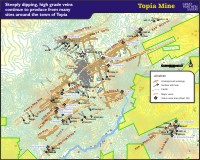 Vein Traces, Drilling and Active Work Areas at the Topia Mine |
 Hormiguera Extension of the Cantarranas Vein |
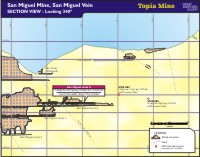 Section through San Miguel Mine |
 Section through Hormiguera Mine |
 Plan view of La Prieta Area |
 Section through La Prieta Area |
 Section through Recompensa and El Rincon Mines |
 Plan of Recompensa and El Rincon Mines |
 Plan View of the La Dura and Don Benito Veins |
 Underground Exploration on the Don Benito South Vein |
 Underground Exploration on the Don Benito North Vein |
 San Gregorio and El Rosario Mines |
 San Gregorio Section View |
 El Rosario Section View |
 Underground Exploration on the Argentina Vein |
 Section view of the Argentina Vein |
Photo Gallery
Click on thumbnails to enlarge
Argentina Mine - Scoop Tram
Argentina Mine - Scoop Tram
Exploration Drilling at San Gregorio Mine
Exploration - Surface Drill at Don Benito Mine
Exploration - Examining Sample
Exploration - Surface Drill at Don Benito Mine
Exploration - Samples
Panoramic - City of Topia
Topia - Underground Mining Truck at Argentina Mine
Topia - Underground Mining Truck at Argentina Mine
Topia - Underground Mining Truck at Argentina Mine
Topia Lab-Cupelation Furnace
Topia Lab-Technician
Topia Mine-Loader at Dos Amigos
Topia Mine-Loading Ore